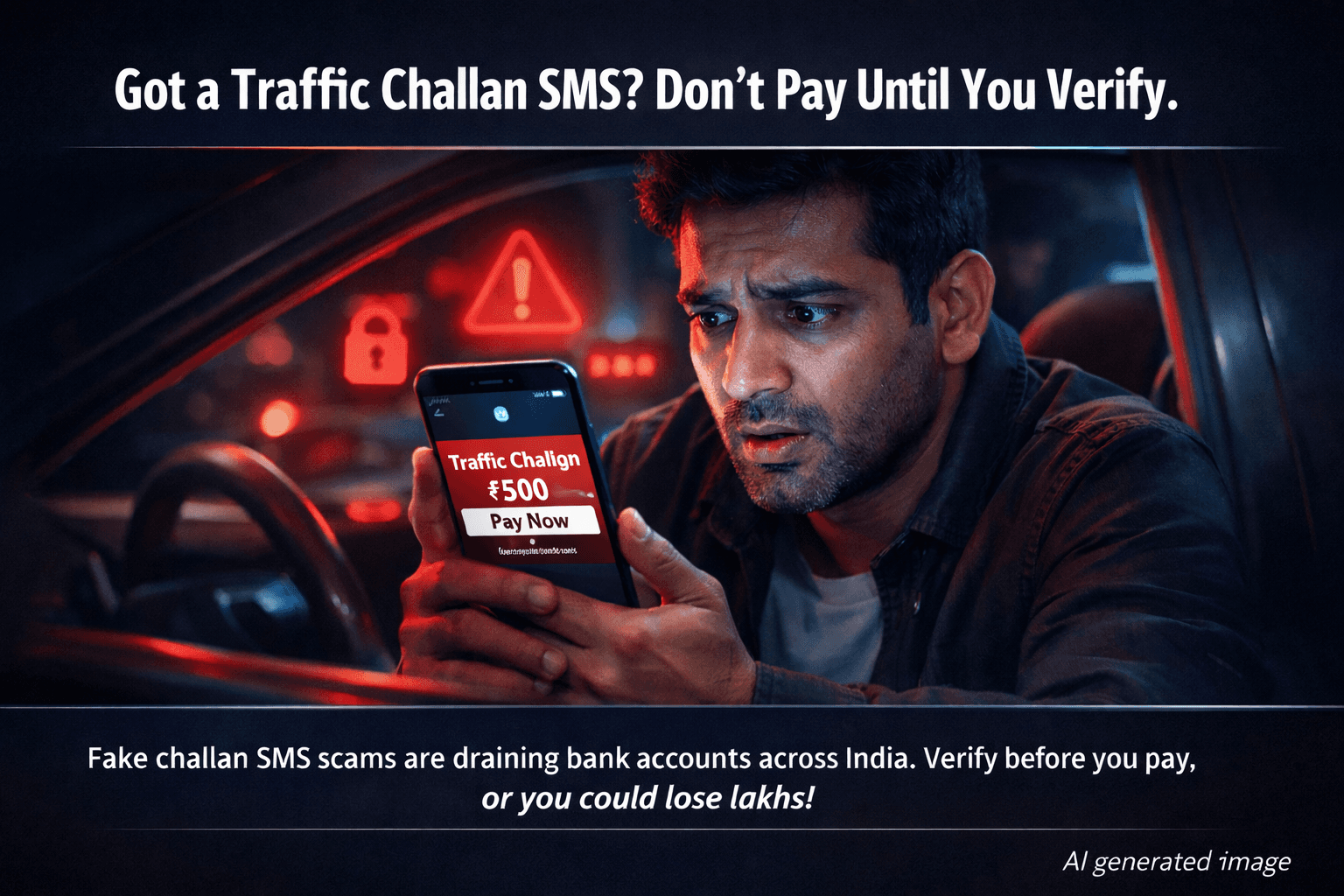
Got a Traffic Challan SMS? Don't Pay Until You Verify.
March 7, 2026
Sai Samarth , Ashok kamat
Got a Traffic Challan SMS? Don't Pay Until You Verify.
March 7, 2026
Sai Samarth , Ashok kamat
You get a message. It says your vehicle has a pending traffic challan. The amount is small ₹500, maybe ₹1000. There's a link to pay immediately. A Delhi man clicked that link. He lost ₹2.49 lakh. Here's how to make sure it doesn't happen to you:
Fake traffic challan messages are draining bank accounts across India.
In January 2026, a 65-year-old resident of East Delhi's Laxmi Nagar received a message on his wife's phone a pending traffic challan of ₹500. The link looked real. The payment page looked official. He entered his card details and OTP.
The ₹500 was never charged. Instead, ₹2.49 lakh was debited through unauthorized international transactions.
He thought: "It's just ₹500. Let me clear it quickly."
There was no challan. No violation. No government portal. Only a fake website built to steal his money.
This is not an isolated case. Victims across India from Nashik to Vadodara to Rajkot have lost lakhs to the same scam. A Vadodara businessman lost ₹34.75 lakh after installing a fake RTO e-challan app via WhatsApp. A Nashik man lost ₹6 lakh after a malicious APK remotely accessed his phone. A Rajkot shop owner lost ₹10.81 lakh to a fake traffic challan app that harvested his banking data.
The Indian Cyber Crime Coordination Centre (I4C) under the Ministry of Home Affairs has issued a nationwide alert. This scam is widespread, sophisticated, and growing.
How the Scam Works
Step 1: You receive an SMS or WhatsApp message claiming a traffic challan is pending against your vehicle.
Step 2: The message shows a small amount typically ₹500 to ₹3,000 to seem believable.
Step 3: The link takes you to a website that looks exactly like the official Parivahan e-challan portal. But the URL is slightly different for example, echallan.pasvahan.icu instead of echallan.parivahan.gov.in. One letter changed. That's all it takes.
Step 4: You enter your vehicle details. The site "confirms" a challan even for random, invalid vehicle numbers.
Step 5: You enter your card details and OTP. The displayed amount is small, but the actual transaction processed is significantly higher sometimes in lakhs.
In some cases, clicking the link installs malware (APK files) that can intercept your OTPs, access your SMS, and drain your account silently.
What Victims Tell Us
"The message had my vehicle number. It looked completely real." "I thought ₹500 was too small for someone to fake." "I didn't notice the URL was different until it was too late." "I was driving and just wanted to clear it quickly."
These scams are designed to exploit urgency, not carelessness.
Not Sure If That Challan Message Is Real?
Send us a screenshot of the message. We'll tell you if it's genuine or a scam.
💬 WhatsApp: +91 99644 43350 📧 Email: contact@cybersecify.com
(No charges. No judgment.)
What Happens When You Contact Us
We do not report you to the police
We do not ask for documents or payments
We do not interrogate or judge
We only verify whether it's real or a scam
How to Spot a Fake Traffic Challan
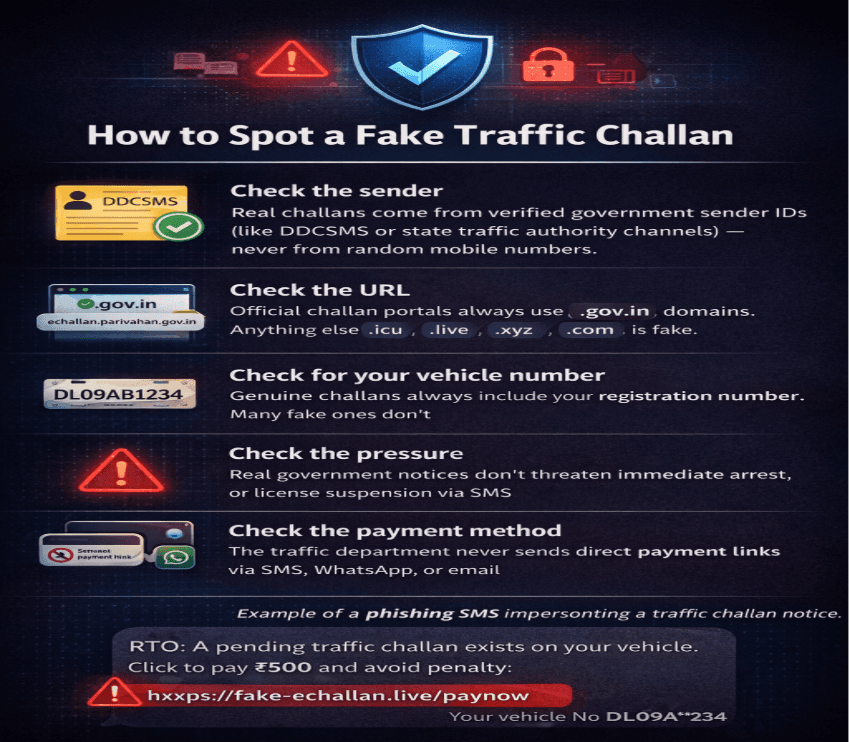
Check the sender: Real challans come from verified government sender IDs (like DDCSMS or state traffic authority channels) never from random mobile numbers
Check the URL: Official challan portals always use .gov.in domains. Anything else .icu, .live, .xyz, .com is fake
Check for your vehicle number: Genuine challans always include your registration number. Many fake ones don't
Check the pressure: Real government notices don't threaten immediate arrest or license suspension via SMS
Check the payment method: The traffic department never sends direct payment links via SMS, WhatsApp, or email
If any of the above red flags are present, it's a scam.
Already Clicked a Link or Made a Payment?
Act within the first 60 minutes the "Golden Hour" to limit your loss.
Take screenshots of the message, link, and any payment confirmations
Call your bank immediately and block your card
Call 1930 National Cyber Crime Helpline
Report at cybercrime.gov.in
Contact us we'll guide you on next steps
🆘 SOS HELP
Need Help Beyond Verification?
If you've already lost money or need to file a complaint:
We guide you through the FIR filing process
We help you report on the National Cybercrime Portal
We assist with documenting evidence for legal proceedings
This is a paid service.
💬 WhatsApp: +91 99644 43350 to discuss. Contact us on WhatsApp
Report Fraud
If you are a victim of online fraud:
National Cyber Crime Portal: cybercrime.gov.in
Helpline: 1930
Sanchar Saathi: sancharsaathi.gov.in
Always Remember
Do NOT click on any links received from unknown numbers claiming pending challans
Do NOT share card details, OTPs, CVV, or personal information with anyone
Do NOT download apps received via WhatsApp or SMS
Verify challan details only through official portals: echallan.parivahan.gov.in or your state traffic police website
If you receive any suspicious SMS, e-mail, or call, report it to Sanchar Saathi at sancharsaathi.gov.in and to ICICI Bank at antiphishing@icicibank.com
Who We Are
Cyber Secify is a Bengaluru-based cybersecurity consultancy. We help people verify suspicious calls, messages, links, apps, and impersonation attempts before they turn into financial or legal damage. We are not police. We don't interrogate. We verify.
Previous Blog
If you missed our previous post on digital arrest scams where callers impersonate police officers:
Read: Got a Suspicious Call From 'Police'? We'll Verify It for Free
References
Delhi man loses ₹2.49 lakh to fake traffic challan
Delhi man loses ₹4 lakh via WhatsApp fake challan
https://thecsrjournal.in/delhi-man-loses-₹4-lakh-in-whatsapp-fake-challan-scam/
I4C nationwide alert on fake e-challan phishing
https://www.newsx.com/india/fake-e-challan-sms-alert-one-click-on-a-fraud-link-can-drain-your-bank-account-in-minutes-heres-how-to-verify-174019/RTO Challan Fraud: APK-Based Financial Theft
Rajasthan Police warns of fake traffic challan SMS scam https://www.newkerala.com/news/o/fraudulent-challans-fake-payment-gateways-used-scams-rajasthan-police-182
Official Sources
Ministry of Road Transport Parivahan e-Challan: https://echallan.parivahan.gov.in
National Cybercrime Portal: https://cybercrime.gov.in
Sanchar Saathi: https://sancharsaathi.gov.in
Disclaimer: Cyber Secify is an independent cybersecurity consultancy. Not affiliated with any government agency.

Need help? WhatsApp us: +91 99644 43350
🌐 https://cybersecify.com | 📧 contact@cybersecify.com 💬 Contact us on WhatsApp
Fake traffic challan messages are draining bank accounts across India.
In January 2026, a 65-year-old resident of East Delhi's Laxmi Nagar received a message on his wife's phone a pending traffic challan of ₹500. The link looked real. The payment page looked official. He entered his card details and OTP.
The ₹500 was never charged. Instead, ₹2.49 lakh was debited through unauthorized international transactions.
He thought: "It's just ₹500. Let me clear it quickly."
There was no challan. No violation. No government portal. Only a fake website built to steal his money.
This is not an isolated case. Victims across India from Nashik to Vadodara to Rajkot have lost lakhs to the same scam. A Vadodara businessman lost ₹34.75 lakh after installing a fake RTO e-challan app via WhatsApp. A Nashik man lost ₹6 lakh after a malicious APK remotely accessed his phone. A Rajkot shop owner lost ₹10.81 lakh to a fake traffic challan app that harvested his banking data.
The Indian Cyber Crime Coordination Centre (I4C) under the Ministry of Home Affairs has issued a nationwide alert. This scam is widespread, sophisticated, and growing.
How the Scam Works
Step 1: You receive an SMS or WhatsApp message claiming a traffic challan is pending against your vehicle.
Step 2: The message shows a small amount typically ₹500 to ₹3,000 to seem believable.
Step 3: The link takes you to a website that looks exactly like the official Parivahan e-challan portal. But the URL is slightly different for example, echallan.pasvahan.icu instead of echallan.parivahan.gov.in. One letter changed. That's all it takes.
Step 4: You enter your vehicle details. The site "confirms" a challan even for random, invalid vehicle numbers.
Step 5: You enter your card details and OTP. The displayed amount is small, but the actual transaction processed is significantly higher sometimes in lakhs.
In some cases, clicking the link installs malware (APK files) that can intercept your OTPs, access your SMS, and drain your account silently.
What Victims Tell Us
"The message had my vehicle number. It looked completely real." "I thought ₹500 was too small for someone to fake." "I didn't notice the URL was different until it was too late." "I was driving and just wanted to clear it quickly."
These scams are designed to exploit urgency, not carelessness.
Not Sure If That Challan Message Is Real?
Send us a screenshot of the message. We'll tell you if it's genuine or a scam.
💬 WhatsApp: +91 99644 43350 📧 Email: contact@cybersecify.com
(No charges. No judgment.)
What Happens When You Contact Us
We do not report you to the police
We do not ask for documents or payments
We do not interrogate or judge
We only verify whether it's real or a scam
How to Spot a Fake Traffic Challan
Check the sender: Real challans come from verified government sender IDs (like DDCSMS or state traffic authority channels) never from random mobile numbers
Check the URL: Official challan portals always use .gov.in domains. Anything else .icu, .live, .xyz, .com is fake
Check for your vehicle number: Genuine challans always include your registration number. Many fake ones don't
Check the pressure: Real government notices don't threaten immediate arrest or license suspension via SMS
Check the payment method: The traffic department never sends direct payment links via SMS, WhatsApp, or email
If any of the above red flags are present, it's a scam.
Already Clicked a Link or Made a Payment?
Act within the first 60 minutes the "Golden Hour" to limit your loss.
Take screenshots of the message, link, and any payment confirmations
Call your bank immediately and block your card
Call 1930 National Cyber Crime Helpline
Report at cybercrime.gov.in
Contact us we'll guide you on next steps
🆘 SOS HELP
Need Help Beyond Verification?
If you've already lost money or need to file a complaint:
We guide you through the FIR filing process
We help you report on the National Cybercrime Portal
We assist with documenting evidence for legal proceedings
This is a paid service.
💬 WhatsApp: +91 99644 43350 to discuss. Contact us on WhatsApp
Report Fraud
If you are a victim of online fraud:
National Cyber Crime Portal: cybercrime.gov.in
Helpline: 1930
Sanchar Saathi: sancharsaathi.gov.in
Always Remember
Do NOT click on any links received from unknown numbers claiming pending challans
Do NOT share card details, OTPs, CVV, or personal information with anyone
Do NOT download apps received via WhatsApp or SMS
Verify challan details only through official portals: echallan.parivahan.gov.in or your state traffic police website
If you receive any suspicious SMS, e-mail, or call, report it to Sanchar Saathi at sancharsaathi.gov.in and to ICICI Bank at antiphishing@icicibank.com
Who We Are
Cyber Secify is a Bengaluru-based cybersecurity consultancy. We help people verify suspicious calls, messages, links, apps, and impersonation attempts before they turn into financial or legal damage. We are not police. We don't interrogate. We verify.
Previous Blog
If you missed our previous post on digital arrest scams where callers impersonate police officers:
Read: Got a Suspicious Call From 'Police'? We'll Verify It for Free
References
Delhi man loses ₹2.49 lakh to fake traffic challan
Delhi man loses ₹4 lakh via WhatsApp fake challan
https://thecsrjournal.in/delhi-man-loses-₹4-lakh-in-whatsapp-fake-challan-scam/
I4C nationwide alert on fake e-challan phishing
https://www.newsx.com/india/fake-e-challan-sms-alert-one-click-on-a-fraud-link-can-drain-your-bank-account-in-minutes-heres-how-to-verify-174019/RTO Challan Fraud: APK-Based Financial Theft
Rajasthan Police warns of fake traffic challan SMS scam https://www.newkerala.com/news/o/fraudulent-challans-fake-payment-gateways-used-scams-rajasthan-police-182
Official Sources
Ministry of Road Transport Parivahan e-Challan: https://echallan.parivahan.gov.in
National Cybercrime Portal: https://cybercrime.gov.in
Sanchar Saathi: https://sancharsaathi.gov.in
Disclaimer: Cyber Secify is an independent cybersecurity consultancy. Not affiliated with any government agency.
Need help? WhatsApp us: +91 99644 43350
🌐 https://cybersecify.com | 📧 contact@cybersecify.com 💬 Contact us on WhatsApp
You get a message. It says your vehicle has a pending traffic challan. The amount is small ₹500, maybe ₹1000. There's a link to pay immediately. A Delhi man clicked that link. He lost ₹2.49 lakh. Here's how to make sure it doesn't happen to you:
Fake traffic challan messages are draining bank accounts across India.
In January 2026, a 65-year-old resident of East Delhi's Laxmi Nagar received a message on his wife's phone a pending traffic challan of ₹500. The link looked real. The payment page looked official. He entered his card details and OTP.
The ₹500 was never charged. Instead, ₹2.49 lakh was debited through unauthorized international transactions.
He thought: "It's just ₹500. Let me clear it quickly."
There was no challan. No violation. No government portal. Only a fake website built to steal his money.
This is not an isolated case. Victims across India from Nashik to Vadodara to Rajkot have lost lakhs to the same scam. A Vadodara businessman lost ₹34.75 lakh after installing a fake RTO e-challan app via WhatsApp. A Nashik man lost ₹6 lakh after a malicious APK remotely accessed his phone. A Rajkot shop owner lost ₹10.81 lakh to a fake traffic challan app that harvested his banking data.
The Indian Cyber Crime Coordination Centre (I4C) under the Ministry of Home Affairs has issued a nationwide alert. This scam is widespread, sophisticated, and growing.
How the Scam Works
Step 1: You receive an SMS or WhatsApp message claiming a traffic challan is pending against your vehicle.
Step 2: The message shows a small amount typically ₹500 to ₹3,000 to seem believable.
Step 3: The link takes you to a website that looks exactly like the official Parivahan e-challan portal. But the URL is slightly different for example, echallan.pasvahan.icu instead of echallan.parivahan.gov.in. One letter changed. That's all it takes.
Step 4: You enter your vehicle details. The site "confirms" a challan even for random, invalid vehicle numbers.
Step 5: You enter your card details and OTP. The displayed amount is small, but the actual transaction processed is significantly higher sometimes in lakhs.
In some cases, clicking the link installs malware (APK files) that can intercept your OTPs, access your SMS, and drain your account silently.
What Victims Tell Us
"The message had my vehicle number. It looked completely real." "I thought ₹500 was too small for someone to fake." "I didn't notice the URL was different until it was too late." "I was driving and just wanted to clear it quickly."
These scams are designed to exploit urgency, not carelessness.
Not Sure If That Challan Message Is Real?
Send us a screenshot of the message. We'll tell you if it's genuine or a scam.
💬 WhatsApp: +91 99644 43350 📧 Email: contact@cybersecify.com
(No charges. No judgment.)
What Happens When You Contact Us
We do not report you to the police
We do not ask for documents or payments
We do not interrogate or judge
We only verify whether it's real or a scam
How to Spot a Fake Traffic Challan
Check the sender: Real challans come from verified government sender IDs (like DDCSMS or state traffic authority channels) never from random mobile numbers
Check the URL: Official challan portals always use .gov.in domains. Anything else .icu, .live, .xyz, .com is fake
Check for your vehicle number: Genuine challans always include your registration number. Many fake ones don't
Check the pressure: Real government notices don't threaten immediate arrest or license suspension via SMS
Check the payment method: The traffic department never sends direct payment links via SMS, WhatsApp, or email
If any of the above red flags are present, it's a scam.
Already Clicked a Link or Made a Payment?
Act within the first 60 minutes the "Golden Hour" to limit your loss.
Take screenshots of the message, link, and any payment confirmations
Call your bank immediately and block your card
Call 1930 National Cyber Crime Helpline
Report at cybercrime.gov.in
Contact us we'll guide you on next steps
🆘 SOS HELP
Need Help Beyond Verification?
If you've already lost money or need to file a complaint:
We guide you through the FIR filing process
We help you report on the National Cybercrime Portal
We assist with documenting evidence for legal proceedings
This is a paid service.
💬 WhatsApp: +91 99644 43350 to discuss. Contact us on WhatsApp
Report Fraud
If you are a victim of online fraud:
National Cyber Crime Portal: cybercrime.gov.in
Helpline: 1930
Sanchar Saathi: sancharsaathi.gov.in
Always Remember
Do NOT click on any links received from unknown numbers claiming pending challans
Do NOT share card details, OTPs, CVV, or personal information with anyone
Do NOT download apps received via WhatsApp or SMS
Verify challan details only through official portals: echallan.parivahan.gov.in or your state traffic police website
If you receive any suspicious SMS, e-mail, or call, report it to Sanchar Saathi at sancharsaathi.gov.in and to ICICI Bank at antiphishing@icicibank.com
Who We Are
Cyber Secify is a Bengaluru-based cybersecurity consultancy. We help people verify suspicious calls, messages, links, apps, and impersonation attempts before they turn into financial or legal damage. We are not police. We don't interrogate. We verify.
Previous Blog
If you missed our previous post on digital arrest scams where callers impersonate police officers:
Read: Got a Suspicious Call From 'Police'? We'll Verify It for Free
References
Delhi man loses ₹2.49 lakh to fake traffic challan
Delhi man loses ₹4 lakh via WhatsApp fake challan
https://thecsrjournal.in/delhi-man-loses-₹4-lakh-in-whatsapp-fake-challan-scam/
I4C nationwide alert on fake e-challan phishing
https://www.newsx.com/india/fake-e-challan-sms-alert-one-click-on-a-fraud-link-can-drain-your-bank-account-in-minutes-heres-how-to-verify-174019/RTO Challan Fraud: APK-Based Financial Theft
Rajasthan Police warns of fake traffic challan SMS scam https://www.newkerala.com/news/o/fraudulent-challans-fake-payment-gateways-used-scams-rajasthan-police-182
Official Sources
Ministry of Road Transport Parivahan e-Challan: https://echallan.parivahan.gov.in
National Cybercrime Portal: https://cybercrime.gov.in
Sanchar Saathi: https://sancharsaathi.gov.in
Disclaimer: Cyber Secify is an independent cybersecurity consultancy. Not affiliated with any government agency.
Need help? WhatsApp us: +91 99644 43350
🌐 https://cybersecify.com | 📧 contact@cybersecify.com 💬 Contact us on WhatsApp
Other Blogs
Other Blogs
Check our other project Blogs with useful insight and information for your businesses

Other Blogs
Other Blogs
Check our other project Blogs with useful insight and information for your businesses

Uncover vulnerabilities before attackers do


Uncover vulnerabilities before attackers do
Uncover vulnerabilities before attackers do