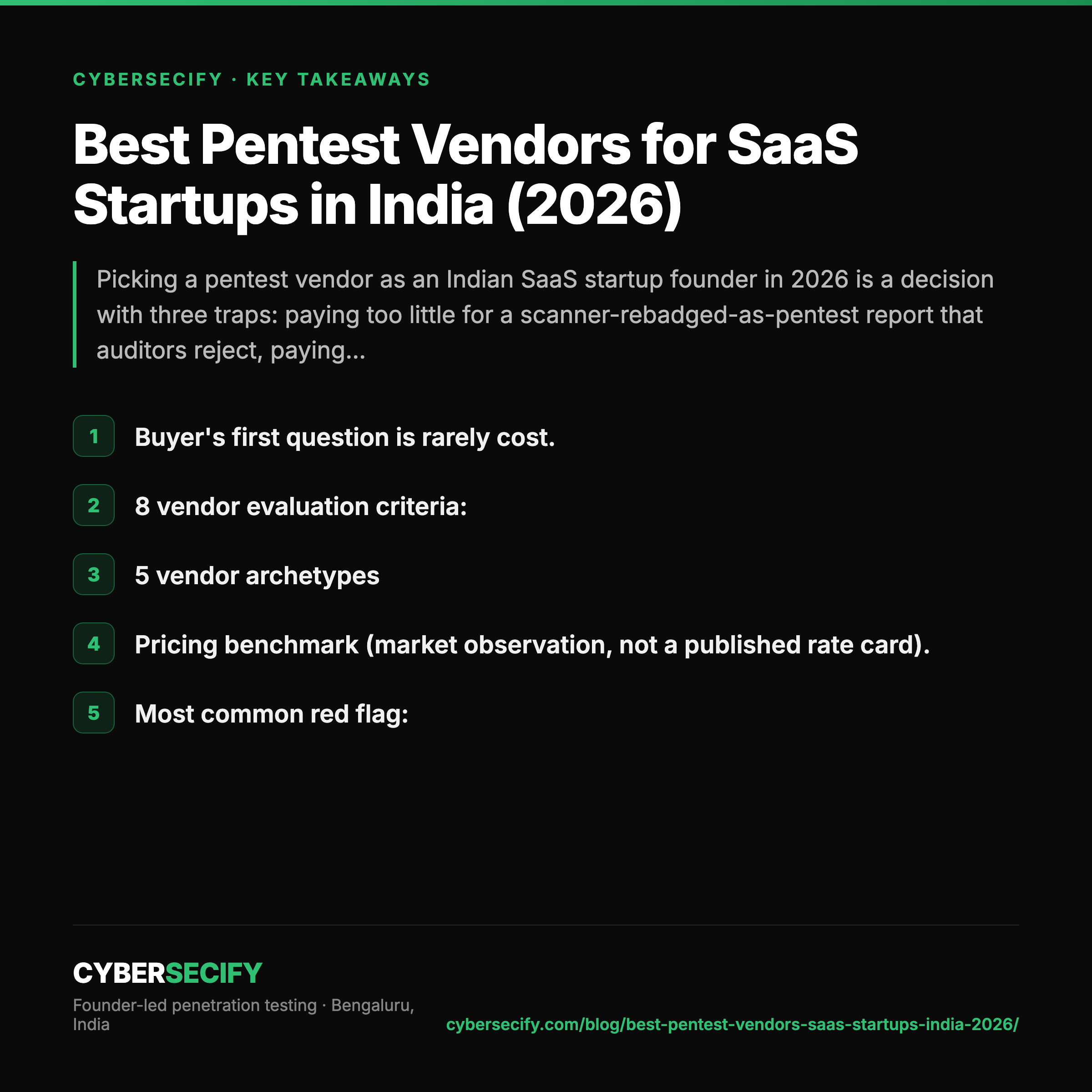
Picking a pentest vendor as an Indian SaaS startup founder in 2026 is a decision with three traps: paying too little for a scanner-rebadged-as-pentest report that auditors reject, paying too much for a CERT-In empanelled vendor when your buyers do not require it, or picking on the wrong axis entirely (cheapest, fastest, biggest). This guide walks 8 vendor evaluation criteria, the 5 vendor archetypes active in the Indian market, pricing benchmarks per tier, and a decision matrix by persona (pre-Series-A, Series A, Series B). For founders who want to skip the comparison and see what a transparent, founder-led pentest engagement looks like, Cybersecify pricing is published and our SOC 2 + ISO 27001 ready pentest report sample is downloadable.
Key findings
- Buyer’s first question is rarely cost. It is “will this report be accepted by my customer, my auditor, or my investor.” Below the audit-acceptable floor (INR 75,000 for single scope), the spend is zero value because the deliverable gets rejected.
- 8 vendor evaluation criteria: methodology disclosure, tester qualifications, founder involvement, retest policy, report deliverable format, India entity for billing, audit acceptance history, pricing transparency.
- 5 vendor archetypes in the Indian market: boutique founder-led firms, Bangalore-based generalist agencies, CERT-In empanelled enterprise vendors, global compliance-stack vendors, freelancer / individual OSCP testers.
- Pricing benchmark (market observation, not a published rate card). Budget tier INR 50K to 1L (scanner output, usually rejected by auditors). Professional tier INR 1L to 3L (methodology-driven, audit-acceptable). Enterprise tier INR 3L to 15L+ (multi-week, often CERT-In empanelled). Cybersecify Startup INR 74,999 and Growth INR 1,79,999 sit in the professional tier.
- Most common red flag: methodology vagueness. A vendor that says only OWASP without naming OWASP WSTG v4.2 or another framework version is signaling scanner-driven testing or copied marketing.
- CERT-In empanelment is not required for most SaaS startups. It is a regulatory requirement for government / PSU / BFSI / telecom / power / CII engagements only. Most private SaaS startups, including those selling to enterprise customers, do not need it.
- Boring-but-right answer: for pre-Series-A to Series-A Indian SaaS startups facing a customer security questionnaire or first SOC 2 push, a boutique founder-led firm in the INR 75K to 2L range, OSCP-led, with a published price tag and a sample report, is the right pick.
- Founder involvement is the highest-signal differentiator between predictable-quality and variable-quality engagements. If a sales executive scopes the engagement and you never speak to a tester, expect deliverable quality to vary by which tester gets assigned.
For our own scope and published pricing, see penetration testing companies in Bengaluru.
Cybersecify is a founder-led penetration testing firm based in Bengaluru (Bangalore), India. We pentest SaaS startups across India, Australia, EU, Hong Kong, with founder-led delivery on every engagement. The patterns and pricing tiers below come from real customer evaluation conversations, not theoretical market analysis. For the deliverable format auditors and enterprise security teams expect, see our pentest report sample.
What buyers actually evaluate
Criterion 1: Methodology disclosure
Real vendors name their methodology explicitly: PTES (Penetration Testing Execution Standard), OWASP WSTG v4.2 (Web Security Testing Guide), OWASP API Security Top 10, OWASP MASTG (Mobile Application Security Testing Guide), NIST SP 800-115. Vague vendors say only OWASP without a version, or industry best practices, or comprehensive security testing approach.
The version number matters. OWASP WSTG v4.2 (2020) is the current released Web Security Testing Guide, and the older v4.0 line (2014) has different test cases, different prioritization, and thinner coverage of modern attack surfaces (API, cloud, business logic). A vendor still citing a version from the mid-2010s is operating on a decade-old playbook.
What to ask: “Which version of OWASP WSTG do your testers use, and can you walk me through the phases your pentest follows?”
Criterion 2: Tester qualifications and named individuals
Penetration testing certifications are held by individuals, not companies. The relevant ones, ranked by depth:
- OSCP (Offensive Security Certified Professional): the practical baseline. Requires passing a 24-hour hands-on hacking exam. Industry default minimum for serious pentest work. More on why OSCP-certified testing matters when comparing vendors.
- OSWE (Offensive Security Web Expert): advanced web application focus. Strong fit for SaaS pentest.
- OSEP, OSED, OSCE: deeper specializations. Less common for SaaS pentest, more relevant for red team engagements and exploit development.
- CompTIA PenTest+: foundational, acceptable as supporting cert for junior testers.
- CEH (Certified Ethical Hacker): theory-focused, weaker practical signal than OSCP. Acceptable as supporting cert, not as lead tester credential.
The question to ask: “Who is the lead tester on my engagement, what are their certifications, and can I see their LinkedIn?” If the answer is the firm has OSCP-certified testers but cannot name your specific lead tester, the firm is buying the certification as a marketing claim, not as an engagement guarantee.
Criterion 3: Founder involvement
Boutique founder-led firms differ from generalist agencies in one key way: a founder reviews and signs every report. This is not symbolic. Founder involvement means:
- Scoping conversation is technical, not sales-driven
- Findings get founder-level review before delivery (catches false positives, prioritization errors, missing context)
- Founder is accountable in writing for the deliverable
- Customer can escalate to the founder directly during remediation
What to ask: “Will I speak to a founder during scoping? Does a founder sign the report? Who do I escalate to if I have questions during remediation?”
Criterion 4: Retest policy
Retest practice tells you whether the vendor views findings as work to be closed or revenue to be re-billed. Three retest models active in India:
- 1 retest included free within one month of the v1.0 report: the right model. Aligns vendor with the customer’s outcome (closed findings). Cybersecify uses this model for both Startup and Growth plans.
- Retest billed separately: many vendors do this, often as a meaningful fraction of the original engagement fee. Ask for the retest price in writing before you sign.
- No retest offered: signals the vendor sees pentest as a one-time deliverable, not a process. Avoid.
Why this matters: customer security questionnaires and SOC 2 / ISO 27001 audits ask for evidence of remediation, not just findings. A pentest report with unverified fixes is incomplete evidence.
Criterion 5: Report deliverable format
Audit-acceptable pentest reports have a consistent structure:
- Executive summary (1 to 2 pages, non-technical, severity distribution, business impact)
- Scope and methodology (what was tested, what framework was followed, what was excluded)
- Findings (one per identified issue, with severity, CWE / OWASP mapping, reproduction steps, screenshots, remediation guidance)
- Framework mapping if compliance-relevant (SOC 2 Trust Services Criteria, ISO 27001 Annex A controls, PCI DSS requirements, HIPAA Security Rule)
- Retest report appended after remediation cycle
What to ask: “Can I see a sanitized sample report?” Any serious vendor publishes one. Cybersecify publishes the SOC 2 + ISO 27001 ready pentest report sample directly on the website, no email gate.
Criterion 6: India entity for billing
For Indian SaaS startups, vendor entity geography affects:
- FX exposure: USD-billing vendors expose you to FX volatility on annual contracts and on retest billing
- GST handling: Indian vendors charge GST at 18 percent (claimable as input credit); foreign vendors do not, but you owe equalisation levy on certain digital services
- Contract law: Indian Contract Act vs foreign jurisdiction. Indian jurisdiction is faster and cheaper to enforce
- Data localisation: under DPDP Act 2023, transferring customer data to a foreign pentest vendor may carry additional consent and notification obligations
For most Indian SaaS startups, an Indian-entity vendor is operationally simpler. International vendors are sometimes worth the friction (specific specialization, US enterprise customer requirement), but default to India.
Criterion 7: Audit acceptance history
Ask the vendor to name the SOC 2 / ISO 27001 audit firms their prior clients used, so you can gauge fit with your own auditor. CERT-In empanelment is a separate question (only relevant for regulated sectors).
The vendor should also be able to name specific customer types: “we have pentested Series A SaaS startups for SOC 2 Type 1, regulated fintech for RBI cybersecurity directive, healthcare SaaS for HIPAA.” Generic claims (we have pentested over 100 customers) without persona specificity is a soft red flag.
Criterion 8: Pricing transparency
Vendors with published price tags on the website signal confidence in their pricing model and respect for the founder’s time. If a vendor will not quote without a sales call, ask what inputs drive the number and ask for the quote in writing against a fixed scope, so you can compare like for like.
The published-price model has limits: enterprise engagements with custom scope, regulated industry engagements, or specialty engagements (IoT, embedded, ICS) often legitimately require a quote. But for standard web app + API SaaS pentest, the price should be transparent.
Vendor archetypes in the Indian market
| Archetype | Pricing range | Founder involvement | Retest included | India entity | Persona fit |
|---|---|---|---|---|---|
| Boutique founder-led firm (e.g., Cybersecify) | Cybersecify publishes INR 74,999 and INR 1,79,999; most others quote per scope | Yes, on every engagement | Yes, 1 free retest within one month of the v1.0 report | Yes | Pre-Series-A to Series-B SaaS, first SOC 2, customer questionnaire pressure |
| Bangalore-based generalist agency | Not published; ask for a quote | Variable, often sales-led | Ask; sometimes billed extra | Yes | Series A to Series C SaaS with budget for project management overhead |
| CERT-In empanelled enterprise vendor | Not published; ask for a quote | Structured project management | Ask | Yes | BFSI, telecom, power, government, CII, regulated SaaS |
| Global compliance-stack vendor (US-headquartered) | Mostly quote-based; Software Secured lists starting prices from USD 5,400 to USD 21,400 by scope type on its pricing page, checked August 2026 | Varies | Ask | Ask whether delivery is in-house or subcontracted | Series B+ SaaS with US enterprise customers and USD revenue |
| Freelancer / individual OSCP tester | Negotiated per engagement | Yes (the freelancer is the firm) | Negotiated case-by-case | No firm entity, GST-individual | Pre-seed founders with budget constraint and willingness to accept no entity liability |
Each archetype is the right answer for a specific persona. Most Indian SaaS startups in the pre-Series-A to Series-A stage hit the right balance with the boutique founder-led archetype.
Per-vendor profile: who is actually in this market
Named vendors active in the Indian SaaS pentest market as of 2026, mapped to the archetypes above. Profiles describe each vendor’s publicly stated positioning (their website copy, listed methodology, published pricing, billing entity). This is fit-to-persona mapping, not a quality ranking.
Cybersecify (boutique founder-led, Bengaluru)
- Headquarters: Bengaluru, India entity, INR billing with GST input credit
- Founders on every engagement: Rathnakara GN (M.Sc Cyber Security, OSCP) leads delivery. Ashok Kamat handles scoping, consulting, and compliance mapping
- Published pricing: Startup INR 74,999 (1 scope, 5 business days). Growth INR 1,79,999 (2 scopes, 10 business days, SOC 2 + ISO 27001 audit prep, Letter of Attestation)
- Methodology: OWASP Top 10:2025 + PTES on Startup; OWASP WSTG v4.2, OWASP API Security Top 10, OWASP MASTG and NIST SP 800-115 test-case coverage added on Growth
- Retest: 1 free retest included with both plans (within one month of the v1.0 report)
- Sample report: published publicly without email gate
- Persona fit: pre-Series-A to Series-B SaaS facing a customer security questionnaire, a first SOC 2 / ISO 27001 push, or an investor diligence call
For a transparent founder-to-founder scoping conversation, book a free 30-min call or read Cybersecify pricing.
Astra Security (PTaaS, India entity)
- Headquarters: Delhi NCR, India entity
- Model: PTaaS (Pentest-as-a-Service). Dashboard-led, productized. Scanner plus manual hybrid delivery
- Published pricing: website-listed tiers
- Persona fit: founders who want a dashboard-led experience and recurring scanning alongside engagements
BreachLock (PTaaS hybrid, India + US)
- Headquarters: US-incorporated, India delivery operations
- Model: PTaaS hybrid. Dashboard-led with manual depth available on demand
- Published pricing: sales call required for most engagement sizes
- Persona fit: Series B+ SaaS that want dashboard continuity across multiple engagements plus a US-incorporated vendor for US enterprise procurement
Cobalt.io (US-headquartered PTaaS, distributed testers)
- Headquarters: San Francisco
- Model: PTaaS using a vetted distributed tester pool (“Core”)
- Billing: USD, no Indian entity
- Persona fit: Series B+ SaaS with USD revenue and US enterprise customers that prefer a US-billed vendor on the AP ledger
TCS, Wipro, Infosys, HCL, KPMG, Deloitte, EY, PwC (enterprise / Big 4)
- Headquarters: varies. All have India delivery footprints
- Model: enterprise project-management-led, with a scoping, delivery and review structure sized for multi-scope programmes. Ask who will run your specific engagement and who reviews the report
- Empanelment: most are CERT-In empanelled
- Published pricing: not public. Quote-based, scope-dependent
- Persona fit: regulated BFSI / telecom / power / government / CII engagements that require empanelment. Large multi-product Series-C+ engagements with dedicated PMO
Sprinto, Vanta, Drata, Secureframe (compliance-stack vendors with pentest add-on)
- Headquarters: varies. Sprinto India entity. Vanta / Drata / Secureframe US-incorporated
- Primary product: compliance automation (SOC 2, ISO 27001 evidence collection, control monitoring)
- Pentest: varies by platform, and it changes. Some route to a partner marketplace, some bundle an automated test into the subscription, some treat it as out of scope
- Persona fit: founders already inside one of these compliance platforms who want a single procurement workflow for compliance plus pentest. Confirm with the platform whether the pentest is delivered in-house, bundled as an automated test, or referred to a partner, then apply the 8 evaluation criteria above to whoever actually does the work
Freelance OSCP testers (individual, no entity)
- Headquarters: varies. Usually GST-individual or contract-only
- Billing: per-engagement. No firm-level liability cover
- Methodology: highly tester-dependent. Strong OSCP individuals deliver real depth at low cost. Weaker OSCP individuals deliver scanner output
- Persona fit: pre-seed founders, internal validation work, one-off scoped engagements where the founder explicitly accepts no entity warranty
Decision matrix per persona
| Persona | Recommended approach | Pricing band |
|---|---|---|
| Pre-Series-A SaaS, 1 app, customer security questionnaire | Boutique founder-led firm, Startup-tier engagement | Cybersecify publishes INR 74,999; others quote per scope |
| Series A SaaS, 1 to 2 apps, first SOC 2 or ISO 27001 push | Boutique founder-led firm, Growth-tier engagement with audit prep | Cybersecify publishes INR 1,79,999; others quote per scope |
| Series B SaaS, multi-product, multi-environment | Generalist agency or scaled boutique with custom scope | Not published; ask for a quote |
| Regulated SaaS (RBI / TRAI / DPDP / CERT-In requirements) | CERT-In empanelled vendor | Not published; ask for a quote |
| Pre-seed, no compliance pressure, just want to know what is broken | Freelancer OSCP or budget-tier engagement (accept no audit acceptance guarantee) | Negotiated per engagement |
| US-headquartered SaaS with India delivery ops | Either US-headquartered vendor or India boutique with USD-friendly billing | Mostly quote-based; check each vendor’s pricing page |
5 pentest vendor anti-patterns we see SaaS founders fall into
Five recurring patterns from real founder conversations that explain why first-pentest vendor decisions go wrong.
Anti-pattern 1: Picking the cheapest quote without checking audit acceptance
A INR 50,000 quote looks attractive when the founder has not yet been through a customer security questionnaire or a SOC 2 audit. The deliverable becomes worthless when the customer’s security team or the auditor rejects it. The founder then commissions a second pentest at INR 1,79,999, having spent INR 2,29,999 total to get one usable report. The math always favors the audit-acceptable floor on the first engagement.
Anti-pattern 2: Buying CERT-In empanelment as a quality signal
CERT-In empanelment is a regulatory category, not a quality grade. It signals the vendor has cleared an Indian government empanelment process, which is relevant if the customer is a government department, PSU, bank, NBFC, insurance, telecom, power, or CII entity. For a SaaS startup selling to Razorpay, Freshworks, Postman, or a US enterprise, CERT-In empanelment is irrelevant. Any premium it carries is paying for a regulatory category the buyer does not require. See when you do not need a CERT-In empanelled pentest vendor for the full decision framework.
Anti-pattern 3: Skipping the sample report review
A vendor unable or unwilling to share a sanitized prior report under NDA is asking the founder to buy unverified deliverable quality. The published sample is the lowest-friction way to read a vendor’s executive summary tone, technical depth, reproduction step quality, and remediation guidance. If the sample reads thin, the actual engagement deliverable will not be different. Read the Cybersecify pentest report sample end-to-end before any scoping call.
Anti-pattern 4: Trusting “OSCP-certified team” without a named lead tester
OSCP is held by an individual, not a firm. When the vendor says “our team is OSCP-certified” but cannot name your specific lead tester or share their LinkedIn, the certification is being used as a marketing claim, not as an engagement guarantee. The person who runs the engagement is not always the person whose credential is being cited. The fix is one question: “Who is the lead tester on my engagement, what are their certifications, and can I see their LinkedIn?”
Anti-pattern 5: Picking on size alone (largest = safest)
A 1-app scope is a small engagement inside a large vendor’s portfolio and a large engagement inside a small one. That is worth asking about directly: where does my engagement sit in your schedule, who is assigned to it, and what is their seniority? Size is a useful signal for project management overhead, not for tester depth. For a Series A SaaS founder with one or two production applications, “largest vendor” is usually “lowest engagement priority”.
Sharp recommendations
If you are a pre-Series-A to Series-A Indian SaaS founder and a customer or investor has asked for a pentest report, stop comparing 12 vendors and start comparing 3. The 8 criteria above filter the universe down quickly. Pick a boutique founder-led firm in the INR 75K to 2L range, published pricing, OSCP-led, with a sample report you can read end-to-end, and an India entity for billing.
If you are tempted by the INR 50,000 quote, do the math on the second pentest you will need to commission when the first report gets rejected by your customer’s security team. The cheapest option becomes the most expensive when the deliverable is not audit-acceptable.
Do not buy CERT-In empanelment if your customer is a private enterprise. Empanelled vendors generally price above non-empanelled ones, and the regulatory requirement is real for the sectors it applies to, but for a SaaS startup selling to Razorpay, Freshworks, or a US enterprise, empanelment is irrelevant. It is sold as a quality signal; it is actually a regulatory category.
Do not skip the sample report review. If a vendor cannot share a sanitized prior report under NDA, the deliverable quality is unverifiable. Cybersecify publishes one on the public website precisely because the founder-led commitment requires that the deliverable matches the marketing claim.
Do not pick on price alone, and do not pick on size alone. The right axis is fit-to-persona. A Series A SaaS founder picking the largest enterprise vendor for a 1-app pentest is overbuying. A pre-seed founder picking the cheapest budget vendor for a customer-facing audit deliverable is underbuying. Both fail the audit-acceptable test.
Where to go from here
If you are evaluating pentest vendors and want a transparent scoping conversation founder-to-founder, book a free 30-min call. We will walk your stack (framework, hosting, payment, AI features, compliance pressure), recommend Startup vs Growth scope, and tell you honestly if Cybersecify is the right fit or if a CERT-In empanelled vendor is more aligned with your buyer’s requirements.
For pricing, see Cybersecify Pentest Pricing. For SaaS-specific scope with SOC 2 and ISO 27001 evidence, see our SaaS pentest for India page. For scope and coverage by surface, see our service pages for web application pentest, API pentest, and AI application pentest. For the deliverable format auditors and enterprise security teams expect, see our SOC 2 + ISO 27001 ready pentest report sample.
Related
Pentest Cost India 2026: Plans + Pricing Guide, How to Evaluate a Pentesting Firm, 5 Questions to Ask a Pentest Vendor Before Signing, SOC 2 Pentest Requirements: What Auditors Check, When You Do Not Need a CERT-In Empanelled Pentest Vendor, What a Good Pentest Report Looks Like.
Corrections
-
2026-09-04: Added the source and check date for the Software Secured starting prices in the archetype table; the figures were attributed to the vendor but not linked or dated. Labelled the three-tier pricing benchmark as a market observation rather than a published rate card.
-
2026-08-09: Sayfer was listed as an India-based boutique firm. Sayfer’s own about page gives its location as Tel Aviv, Israel. Corrected.
-
2026-08-09: Removed unsourced price ranges for vendor archetypes and for named categories of firm, and replaced them with “not published, ask for a quote” or with prices the vendor itself publishes. Where a figure is now given, it comes from that vendor’s own pricing page.
-
2026-08-09: Removed unsourced assertions about how named enterprise and Big 4 firms staff and prioritise engagements, including the “3 to 5x” empanelment premium multiplier and the claim that a small scope runs on a large firm’s lowest-billable testers. The buyer advice is now written as questions to ask any vendor.
-
2026-08-09: Removed the claim that compliance platforms do not deliver pentest in-house. Delivery models differ by platform and change over time; readers are now told to confirm with the platform.
-
2026-08-09: Removed the unsourced “retest billed at 25 to 50 percent of the original engagement fee” figure. The advice to get the retest price in writing before signing is unchanged.
-
2026-08-09: Aligned free-retest wording with our published terms: within one month of the v1.0 report.