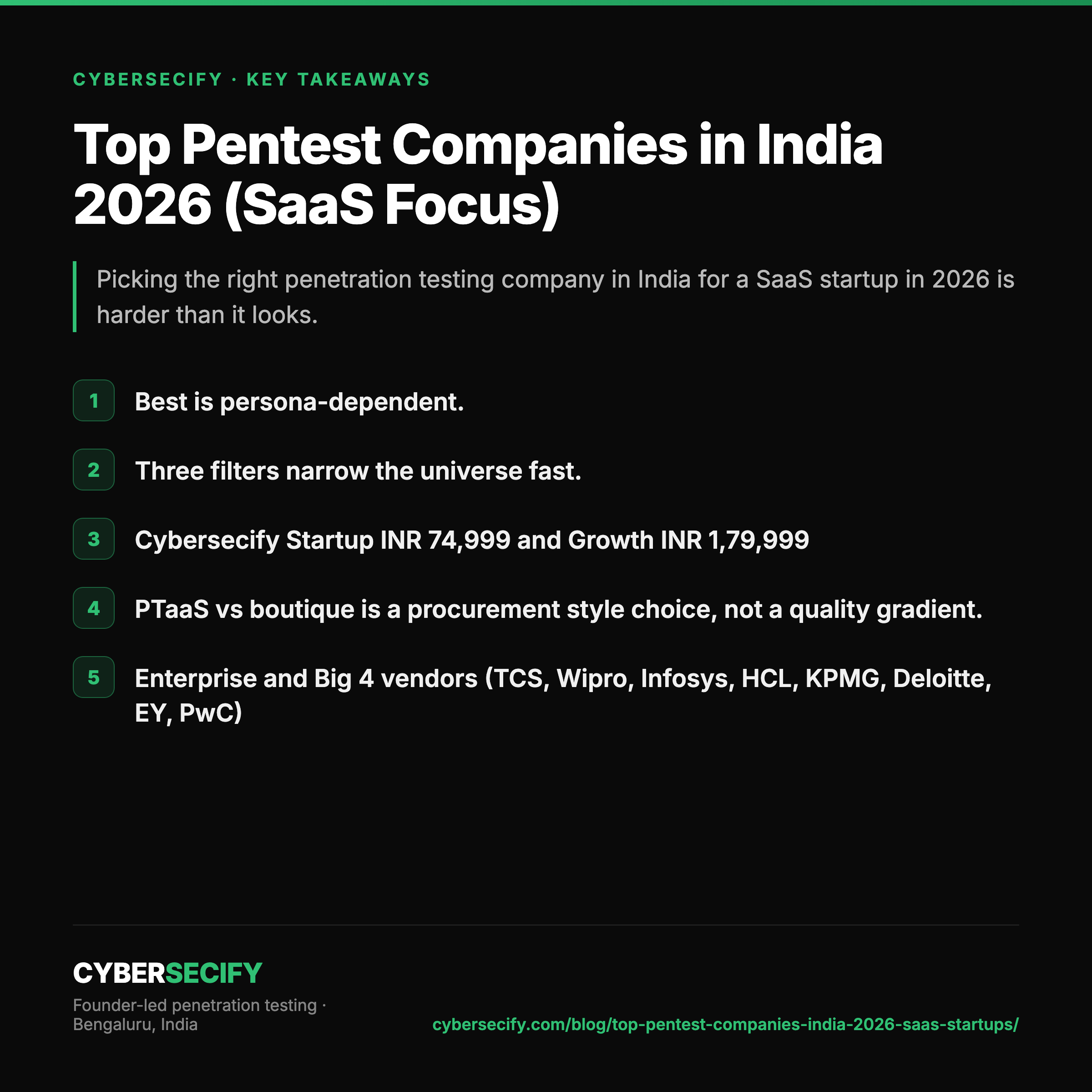
Picking the right penetration testing company in India for a SaaS startup in 2026 is harder than it looks. Ten archetypes are active in the market, pricing spans more than an order of magnitude across them, and most vendor websites read interchangeably. This guide profiles 10 vendor archetypes covering the full delivery-model spectrum (founder-led boutique, PTaaS hybrid, distributed-tester platform, generalist boutique, enterprise / Big 4, compliance-stack add-on, freelance individual), with persona-fit recommendations for pre-Series-A through Series-B SaaS founders. Cybersecify publishes its pricing transparently: Startup Pentest INR 74,999 and Growth Pentest INR 1,79,999 with a public SOC 2 + ISO 27001 ready sample report for verification before any scoping call.
Key findings
- Best is persona-dependent. No single vendor wins for every founder. The right pick depends on funding stage, customer geography, compliance pressure, and procurement style.
- Three filters narrow the universe fast. Audit acceptance of the deliverable, delivery model fit (boutique vs PTaaS vs enterprise vs freelance), and methodology disclosure with named lead tester.
- Cybersecify Startup INR 74,999 and Growth INR 1,79,999 sit in the audit-acceptable professional tier with founder-led delivery, OWASP Top 10:2025 plus PTES methodology on Startup and OWASP WSTG v4.2 test-case coverage on Growth, 1 free retest within one month of the v1.0 report, and sooner if your fixes land before that, and a public sample report.
- PTaaS vs boutique is a procurement style choice, not a quality gradient. Astra, BreachLock, and Cobalt.io fit dashboard-driven recurring engagement workflows. Cybersecify, AppSecure, Payatu, and Qualysec fit point-in-time founder-led engagements.
- Enterprise and Big 4 vendors (TCS, Wipro, Infosys, HCL, KPMG, Deloitte, EY, PwC) are the right fit for BFSI, telecom, power, government, and Critical Information Infrastructure engagements that mandate CERT-In empanelment. Their engagement model is sized for multi-scope programmes, which is more structure than a Series A SaaS with one or two production apps needs.
- Compliance platforms differ on how pentest reaches you. Sprinto, Vanta, Drata, and Secureframe are compliance automation products first. Ask each one directly whether pentest is bundled, referred to a partner, or out of scope. The 8 vendor evaluation criteria still apply to whoever delivers.
- Freelance testers are usually the cheapest option but offer no entity liability and no formal retest commitment. Right fit for pre-seed founders who explicitly accept that trade-off for budget-constrained internal validation work.
- Sample report review is the single highest-signal pre-purchase check. Any vendor unable or unwilling to share a sanitized prior report is asking you to buy unverified deliverable quality. Cybersecify publishes its sample report publicly.
We are based in Bengaluru; scope and price are on our Bengaluru pentest services page.
How we ranked these
This is a fit-to-persona mapping, not a quality leaderboard. The Indian pentest market has many active vendors; the 10 archetypes below cover the full delivery-model spectrum that an Indian SaaS founder will encounter in 2026. Three criteria drove inclusion and ordering:
- Methodology disclosure and audit acceptance. Does the vendor name its methodology (PTES, OWASP WSTG v4.2, OWASP API Security Top 10, NIST SP 800-115) and produce reports accepted by SOC 2 and ISO 27001 auditors plus customer security questionnaires? Vendors with vague methodology language or unverifiable audit history were excluded from individual profiles and rolled into the freelance archetype.
- Persona fit clarity. Each vendor profile names the specific founder persona it fits (pre-Series A, Series A, Series B+, regulated industry, dashboard-driven, hands-on founder-led). A vendor that claims to fit every persona usually fits none well.
- Delivery model differentiation. The 10 entries cover 7 distinct delivery models. Within each model, the vendor named is representative of its archetype; the analysis applies broadly to peers within the same model.
The 10 entries are ordered by delivery model: boutique founder-led first, PTaaS next, enterprise and platform-routed last. The number is a position in that grouping, not a quality score. Entry 1 is not better than entry 9. They are different procurement models, and which one is right depends entirely on what you are buying and who is asking you for it.
How this list is made, and how a company gets on it
Why it exists. To help a buyer match a vendor to an actual requirement. Somebody has asked you for a penetration test, and the useful question is not “who is best” but “which delivery model fits what I am being asked for, at my stage, with my budget and timeline”. A list that crowns a winner cannot answer that. A list that separates delivery models can.
What decides inclusion and placement. The criteria above, applied the same way to every entry: methodology disclosure and audit acceptance, persona fit clarity, and delivery-model differentiation. Placement within the list follows delivery model, not merit.
What does NOT decide it, stated so you can hold us to it. No company has paid to appear here and no company can. Placement is not affected by whether a firm is a partner of ours, whether they link to us, whether they have mentioned us anywhere, or whether they compete with us directly. Several entries compete with us directly and are described on their strengths.
Our own conflict, and how we handle it. We run penetration tests and sell what most of these firms sell, so we appear on this list with that conflict disclosed, not hidden. Judge us from our published pricing, our full sample report and our methodology, against the same criteria you apply to anyone here.
How to be considered, corrected, or removed. If you run a firm that meets the criteria and is not here, or your entry is wrong or out of date, email contact@cybersecify.com with what you want changed and something we can verify: your published methodology, a named lead tester with their certification, your retest policy, and a redacted sample report. We assess against the criteria above, and we will tell you the outcome either way. Factual errors go to errors@cybersecify.com and are handled under our editorial policy, which means a dated correction on the page rather than a quiet edit.
What you should verify yourself, whoever you end up choosing. Ask for the methodology by name and version. Ask who personally runs the test and what they hold. Ask whether a retest is included or billed separately. Ask to see a redacted report before you sign. A vendor who cannot answer those four in writing is telling you something, and it is the same answer whichever list they appear on.
We publish this list and appear on it. The full conflict-of-interest disclosure, the inclusion criteria and what cannot buy a placement are set out below the list.
The 10 companies
1. Cybersecify (boutique founder-led, Bengaluru)
Why a Series A SaaS founder picks Cybersecify first: founder-to-founder scoping with both co-founders on every engagement, OWASP WSTG v4.2 methodology named explicitly, INR pricing published on the website with no sales gate, free retest included, Letter of Attestation as a standard deliverable on the Growth plan.
- Headquarters: Bengaluru (Bangalore), India. India entity, INR billing with GST input credit.
- Delivery model: boutique founder-led. Both co-founders deliver every engagement personally. Rathnakara GN (M.Sc Cyber Security, OSCP) leads pentest delivery. Ashok Kamat handles scoping, consulting, and compliance mapping.
- Published pricing: Startup Pentest INR 74,999 + taxes (1 scope, 5 business days, a report your auditor can use as evidence). Growth Pentest INR 1,79,999 + taxes (2 scopes, 10 business days, SOC 2 + ISO 27001 audit prep, Letter of Attestation, real-world attack simulation beyond OWASP Top 10). Additional scopes INR 74,999 each on the Growth plan (each adds 5 business days by default; parallel testing on request runs scopes 3 and 4 together, bringing a 4-scope engagement to 15 business days; 5 or more move to a custom scoping proposal).
- Methodology: OWASP WSTG v4.2, OWASP API Security Top 10, OWASP MASTG (mobile), PTES (Penetration Testing Execution Standard), NIST SP 800-115.
- Retest: 1 full retest included free within one month of the v1.0 report, on both Startup and Growth plans.
- Sample report: SOC 2 + ISO 27001 ready pentest report published publicly with no email gate.
- Persona fit: pre-Series-A through Series-B SaaS founders facing a customer security questionnaire, a first SOC 2 or ISO 27001 push, or an investor diligence call. Geographic fit covers India-headquartered SaaS, India-headquartered SaaS with US / EU / Australia / Hong Kong customers, and internationally-headquartered SaaS with India delivery operations. Not the right fit: regulated BFSI / telecom / power / government / CII engagements that mandate CERT-In empanelment, or Series-C+ engagements that need 5+ simultaneous testers with dedicated PMO overhead. For a founder-to-founder scoping conversation, book a free 30-min call. For pricing, see Cybersecify Pentest Pricing. For deliverable verification before any scoping call, read the pentest report sample.
2. Astra Security (PTaaS hybrid, Delhi NCR)
- Headquarters: Delhi NCR, India entity.
- Delivery model: PTaaS (Pentest-as-a-Service) hybrid. Dashboard-led, productized engagement workflow. Scanner plus manual hybrid delivery. Strong inbound brand in India.
- Pricing: published. As of August 2026 getastra.com/pricing lists Pentest Basic at USD 1,999 per year and Pentest Plus at USD 5,999 per year, with the Enterprise tier quote-based and scanner tiers priced separately. Check the page for current tiers before you budget.
- Methodology: OWASP and PTES-aligned per their website. Specific version disclosure varies.
- Persona fit: founders who want a dashboard-led recurring scanning experience alongside scheduled manual tests, and prefer a single platform for both scanning and pentest engagement workflow. Strong fit for founders who want vulnerability tracking continuity across multiple engagement cycles. Less suited for founders who prefer founder-to-founder direct engagement without a platform layer.
3. BreachLock (PTaaS hybrid, US-incorporated with India delivery)
- Headquarters: US-incorporated. India delivery operations.
- Delivery model: PTaaS hybrid. Dashboard-led continuous engagement with manual depth available on demand. Subscription model fits multi-engagement cadence.
- Pricing: sales call required for engagement-specific pricing. PTaaS subscription pricing typically requires multi-engagement annual commitment.
- Methodology: named on their website. Visit breachlock.com for current methodology disclosure.
- Persona fit: Series B+ SaaS that want dashboard continuity across multiple engagements, plus a US-incorporated vendor name for US enterprise procurement workflows that prefer US AP ledger entries. Less suited for first-pentest Series A SaaS where a single point-in-time engagement is the actual need.
4. Cobalt.io (US PTaaS using distributed vetted tester pool)
- Headquarters: San Francisco, California, USA.
- Delivery model: PTaaS using a distributed pool of vetted independent pentesters called the Cobalt Core. Dashboard-led scheduling and report delivery. Different lead tester each engagement is typical because of the distributed pool model.
- Billing: USD. No India entity for billing. As of August 2026 cobalt.io/platform/pricing publishes USD 3,500 per test for its Autonomous Pentest; the other tiers are quote-based.
- Methodology: named on cobalt.io. Cobalt-vetted tester pool covers OSCP and OSCE-level practitioners.
- Persona fit: Series B+ SaaS with USD revenue and US enterprise customers that prefer a US-billed vendor on the accounts payable ledger. Fits founders who want a productized engagement experience with dashboard-managed scheduling. Less suited for Indian SaaS startups with India-based revenue where the FX exposure on USD billing and US contract jurisdiction outweighs the platform convenience.
5. Qualysec (Bangalore boutique with SMB + enterprise scope)
- Headquarters: Bangalore, India.
- Delivery model: boutique pentest firm with broader SMB and enterprise scope than founder-only boutiques. Mid-size team capable of handling multi-scope engagements.
- Pricing: sales-call quote per engagement. Visit qualysec.com for current pricing disclosure.
- Methodology: OWASP and PTES-aligned per their website.
- Persona fit: Indian SaaS startups that want a Bangalore-based vendor with broader engagement capacity than a 2-founder boutique can deliver, and are comfortable with a generalist-firm engagement model rather than founder-led delivery. Reasonable fit for Series A through Series B SaaS with multi-scope requirements.
6. AppSecure (India boutique)
- Headquarters: India entity.
- Delivery model: India-based boutique pentest firm with direct engagement model. Named lead tester per engagement.
- Pricing: sales-call quote per engagement. Visit appsecure.security for current pricing disclosure.
- Methodology: OWASP-aligned per their website.
- Persona fit: Indian SaaS startups that want a boutique pentest firm with direct engagement and named tester accountability. Adjacent positioning to Cybersecify on delivery model. Founders comparing boutique vendors should review sample reports from both before deciding.
7. Payatu (India boutique, Pune)
- Headquarters: Pune, India. India entity (Payatu Technologies).
- Delivery model: India-based boutique pentest firm with research-led methodology. Hosts the Nullcon and Hardwear.io conferences. Research depth across web, mobile, IoT, hardware, firmware, and cloud.
- Pricing: sales-call quote per engagement. Visit payatu.com for current pricing disclosure.
- Methodology: OWASP-aligned with active security research publication track record.
- Persona fit: Indian SaaS startups that want a boutique pentest firm with research depth. Strong fit for founders whose stack includes IoT, hardware, or firmware components alongside SaaS. As with other boutique alternatives, sample report review and named lead tester verification are the key pre-purchase checks.
8. Enterprise and Big 4 tier (TCS, Wipro, Infosys, HCL, KPMG, Deloitte, EY, PwC)
- Headquarters: varies. All have India delivery footprints. TCS, Wipro, Infosys, and HCL are India-headquartered. KPMG, Deloitte, EY, and PwC are global Big 4 with India offices.
- Delivery model: enterprise project-managed. A scoping, delivery and review structure sized for multi-scope programmes, with a separate commercial contact from the delivery team. Ask who will run your specific engagement, who reviews the output, and how many of them are on your scope.
- CERT-In empanelment: most are CERT-In empanelled. Verify current empanelment status per vendor at cert-in.org.in.
- Pricing: not public. Quote-based per engagement, scope-dependent, and materially higher than boutique pricing. Multi-week, multi-scope engagement model with programme-management overhead built into pricing. Ask for a like-for-like quote against a boutique bid rather than assuming a multiple.
- Persona fit: regulated BFSI, telecom, power, government, and Critical Information Infrastructure (CII) engagements where CERT-In empanelment is a regulatory requirement. Large Series-C+ engagements with multi-product, multi-environment scope. Enterprise procurement workflows that require brand-name vendors on the approved vendor list. Wrong fit for Series A SaaS with one or two production applications and a customer-questionnaire driver.
For most Series A SaaS startups selling to private enterprises (Razorpay, Freshworks, Postman, US enterprises), CERT-In empanelment is not a requirement. See when you do not need a CERT-In empanelled pentest vendor for the full decision framework.
9. Compliance-stack vendors with pentest add-on (Sprinto, Vanta, Drata, Secureframe)
- Headquarters: Sprinto India entity. Vanta, Drata, and Secureframe US-incorporated.
- Primary product: compliance automation (SOC 2 evidence collection, ISO 27001 control monitoring, continuous compliance dashboards). Pentest is an add-on service routed through a partner marketplace.
- Pentest delivery: varies by platform and by plan, and the arrangements change. Ask the platform directly whether pentest is bundled into your plan, referred to a partner, or out of scope, and who performs the test.
- Pricing: engagement-specific quote. Ask what the quoted price covers, what is excluded, and whether a retest is included.
- Persona fit: founders already inside one of these compliance platforms who want a single procurement workflow for compliance evidence collection plus pentest report. Worth knowing: whoever ends up performing the test, the standard 8 vendor evaluation criteria (methodology disclosure, named lead tester, retest policy, sample report, India entity, audit acceptance history, founder involvement, pricing transparency) still apply to whoever delivers.
10. Freelance OSCP testers (individual contractor)
- Headquarters: varies. Usually GST-individual or contract-only. No firm-level entity.
- Delivery model: the freelancer is the firm. One person scopes, tests, writes the report, and runs any retest. Highly tester-dependent quality.
- Pricing: no published rate card. Quoted per engagement, and usually the cheapest option available.
- Methodology: named by the individual, and quality is entirely individual-dependent. Ask for a sanitized prior report and for the methodology by name and version before you engage. (Why OSCP credentials matter for pentest quality.)
- Persona fit: pre-seed founders with budget constraint and willingness to accept no entity liability, no formal retest commitment, and no firm-level warranty. Suitable for internal validation work, one-off scoped engagements, and bug-bounty-adjacent disclosures where the deliverable does not need to be issued by a registered entity. Not suitable when the deliverable will be shown to a customer security team, an investor, or an auditor expecting an entity-issued report with India contract law jurisdiction.
Who publishes this list, and why we are on it
Cybersecify publishes this list and appears on it. That is a conflict of interest. Here is how we handle it, rather than pretending it away.
Almost every “top pentest companies” list you will find is published by a vendor who ranks itself first. We checked four of the most widely cited ones in August 2026 and each placed itself at or near the top of its own list. Read this one sceptically too.
We took ourselves off this list in August 2026, and then put ourselves back. The reason is worth stating plainly, because it tells you something about how lists like this work. No independent directory or review site currently lists us. So leaving ourselves off did not make the list neutral. It made us invisible to buyers looking for exactly what we do, while every firm below stayed visible. We would rather appear with the conflict disclosed than be absent and unfindable. When third parties carry us, we will revisit this.
The number is a position in the delivery-model grouping, not a quality ranking. No company has paid to appear here and no company can. Placement is not affected by whether a firm partners with us, links to us, or competes with us directly. Several compete with us directly and are described on their strengths.
Everything we claim about ourselves is checkable without asking us: our pricing is published, our sample report is readable in full with no form, and our methodology names the frameworks and versions we work to. Apply the same criteria to us that you apply to anyone below.
Decision matrix per persona
Prices below are shown only where the vendor publishes them. Where a vendor quotes per engagement, that is what the column says.
| Persona | Recommended pick | Published price |
|---|---|---|
| Pre-Series-A SaaS, 1 app, customer security questionnaire | Cybersecify Startup Pentest, or AppSecure / Payatu / Qualysec boutique equivalent | Cybersecify INR 74,999; the others quote per engagement |
| Series A SaaS, 1 to 2 apps, first SOC 2 / ISO 27001 push | Cybersecify Growth Pentest with audit prep included, or comparable boutique with explicit audit prep scope | Cybersecify INR 1,79,999; the others quote per engagement |
| Series B+ SaaS, multi-product, multi-environment | Astra or BreachLock PTaaS hybrid for dashboard-driven cadence, or scaled boutique with custom scope | Astra publishes Pentest Basic USD 1,999/yr and Pentest Plus USD 5,999/yr on its pricing page; BreachLock quotes per engagement |
| Regulated SaaS (BFSI, RBI, TRAI, CERT-In requirements) | Enterprise / Big 4 tier with CERT-In empanelment confirmed on cert-in.org.in | Quote-based |
| Pre-seed, no compliance pressure, just want to know what is broken | Freelance tester, or Cybersecify Startup if the deliverable will be shown externally | Cybersecify INR 74,999; freelance quotes per engagement |
| US-headquartered SaaS with US enterprise customers on USD AP ledger | Cobalt.io for US-billed PTaaS, or BreachLock for US-incorporated PTaaS hybrid | Cobalt publishes USD 3,500 per Autonomous Pentest on its pricing page; other tiers quote-based |
| SaaS already inside Sprinto / Vanta / Drata / Secureframe wanting single procurement | Ask the platform whether pentest is bundled, referred, or out of scope | Engagement-specific quote |
5 anti-patterns SaaS founders fall into when picking a pentest vendor
Anti-pattern 1: Picking based on brand recognition over delivery model fit
A founder reads a list of “top vendors”, recognizes two enterprise names, and assumes brand recognition equals delivery-model fit for their use case. What they buy is an engagement model built for multi-scope programmes applied to a one-app scope, at enterprise pricing, with a commercial contact they will speak to more often than the tester. That is the right product for a different buyer. The fix: pick on delivery model fit (boutique founder-led for hands-on accountability, PTaaS for dashboard-driven recurring cadence, enterprise for regulated empanelment requirements), not on brand recognition.
Anti-pattern 2: Buying the cheapest quote without verifying audit acceptance
A INR 30,000 to 50,000 quote looks attractive when budget is tight, but the deliverable is typically a Burp Suite or OWASP ZAP scan reformatted as a PDF report. When the founder shows the report to their first enterprise customer or their SOC 2 auditor, it gets rejected as scanner output not pentest. The founder then commissions the actual pentest at INR 1.5 lakh to 2 lakh, having spent INR 1.8 lakh to 2.3 lakh total to get one usable report. The math always favors the audit-acceptable floor on the first engagement. For SaaS startups, that floor is around INR 75,000 for single-scope manual pentest, which is exactly where Cybersecify Startup is priced.
Anti-pattern 3: Paying CERT-In empanelment premium when the regulator does not require it
A SaaS founder reads “CERT-In empanelled” on an enterprise vendor’s website and assumes empanelment equals quality. Empanelment is a regulatory category, not a quality grade. It is required for government departments, public sector undertakings, banks, NBFCs, insurance companies, telecom operators, power utilities, and Critical Information Infrastructure entities. For a SaaS startup selling to Razorpay, Freshworks, Postman, or a US enterprise customer, empanelment is irrelevant. Any premium it carries is paying for a regulatory category the buyer does not require. Read when you do not need a CERT-In empanelled pentest vendor for the full decision framework before paying the premium.
Anti-pattern 4: Skipping the sample report review before signing
A vendor unable or unwilling to share a sanitized prior report under NDA is asking the founder to buy unverified deliverable quality. The published sample is the lowest-friction way to read a vendor’s executive summary tone, technical depth, reproduction step quality, and remediation guidance. If the sample reads thin, the actual engagement deliverable will not be different. Cybersecify publishes its pentest report sample publicly precisely because the founder-led commitment requires that the deliverable matches the marketing claim. Before signing with any vendor, read at least one sample report end-to-end and verify it includes per-finding reproduction steps, business impact in plain language, framework mapping if compliance-relevant, and remediation guidance specific to your stack.
Anti-pattern 5: Confusing PTaaS subscription cost with point-in-time engagement cost
A founder comparing Cobalt.io or BreachLock PTaaS subscriptions against boutique point-in-time engagements is comparing two different procurement models. PTaaS subscriptions are usually sold as an annual commitment covering multiple engagements, and amortize across continuous scanning plus scheduled manual tests. Ask each PTaaS vendor for the annual figure at your scope; most do not publish it. A point-in-time boutique engagement (Cybersecify Startup INR 74,999 or Growth INR 1,79,999) is a single engagement deliverable with no annual commitment. PTaaS economics fit Series B+ SaaS with continuous engagement cadence. Point-in-time engagements fit Series A SaaS with first-pentest or annual-pentest cadence. Picking PTaaS for a once-a-year pentest need is overbuying. Picking point-in-time for a continuous quarterly-cadence need is underbuying. The fix: match procurement model to engagement cadence.
Sharp recommendations
If you are a pre-Series-A to Series-A Indian SaaS founder and a customer or investor has asked for a pentest report, narrow the universe fast using the three filters at the top of this article. Pick a boutique founder-led firm in the INR 75K to 2L range with published pricing, OSCP-led testing, a public sample report, and an India entity for billing. Cybersecify fits this persona; AppSecure, Payatu, and Qualysec are adjacent boutique alternatives worth comparing on sample report review. The choice between these is procurement-style preference, not a quality gradient.
If you are tempted by a INR 30,000 to 50,000 quote, do the math on the second pentest you will need to commission when the first scanner-output report gets rejected by your customer’s security team or your auditor. The cheapest option becomes the most expensive when the deliverable is not audit-acceptable. The floor for audit-acceptable single-scope pentest in India is around INR 75,000.
Do not buy CERT-In empanelment if your customer is a private enterprise. The empanelment premium is real, the regulatory requirement is real for the specific sectors that need it, but for a SaaS startup selling to private enterprise customers, empanelment is irrelevant. It is sold as a quality signal; it is actually a regulatory category that you may not need.
If you are evaluating PTaaS vendors (Astra, BreachLock, Cobalt.io), match the procurement model to your actual engagement cadence. PTaaS subscriptions fit continuous quarterly or monthly cadence requirements; they are overkill for first-pentest or annual-pentest needs where a point-in-time boutique engagement delivers equivalent depth at a fraction of the annual commitment.
If you are inside Sprinto, Vanta, Drata, or Secureframe and the compliance platform offers a pentest add-on, verify the partner pentest vendor against the 8 vendor evaluation criteria (methodology disclosure, named lead tester, retest policy, sample report, India entity, audit acceptance history, founder involvement, pricing transparency). Procurement convenience does not exempt the partner pentest vendor from the standard evaluation filters.
Where to go from here
If you are evaluating pentest companies and want a transparent founder-to-founder scoping conversation, book a free 30-min call. We will walk your stack (framework, hosting, payment, AI features, compliance pressure), recommend Startup vs Growth scope, and tell you honestly if Cybersecify is the right fit or if a CERT-In empanelled vendor or a PTaaS subscription is more aligned with your buyer requirements.
For pricing, see Cybersecify Pentest Pricing. For methodology by surface, see our web application pentest service page and API pentest service page. For the deliverable format auditors and enterprise security teams expect, see our SOC 2 + ISO 27001 ready pentest report sample. For pre-purchase verification of your own external attack surface, run a free OpenEASD scan to see what attackers see before any scoping call.
Related
Best Pentest Vendors for SaaS Startups in India 2026, Top Pentest Companies for AI-First SaaS Startups 2026 for the global list if your product has an LLM or agent surface, Pentest Cost India 2026: Plans + Pricing Guide, How to Evaluate a Pentesting Firm, 5 Questions to Ask a Pentest Vendor Before Signing, SOC 2 Pentest Requirements: What Auditors Check, When You Do Not Need a CERT-In Empanelled Pentest Vendor, What a Good Pentest Report Looks Like, DAST vs Pentest: Why Scanner Output Is Not a Security Assessment.
Corrections and updates (4)
We publish corrections rather than editing them away, so a reader who acted on an earlier version can see what changed. Some entries record a change in the source document itself, others record our own error. Dates are our review dates, not the source's change date.
- 2026-08-09: Astra Security and Cobalt.io were described as quote-only. Both publish pentest prices, now cited and linked: Astra Pentest Basic USD 1,999/yr and Pentest Plus USD 5,999/yr (getastra.com/pricing), Cobalt Autonomous Pentest USD 3,500 per test (cobalt.io/platform/pricing).
- 2026-08-09: Removed unsourced price multipliers and price bands attributed to named third parties, including the “3 to 5x boutique pricing” enterprise premium, the freelance “30 to 50 percent below boutique” figure, the PTaaS annual-commitment range, and the per-persona INR pricing column for vendors that do not publish prices.
- 2026-08-09: Replaced assertions about how named enterprise and Big 4 firms staff and deliver engagements with questions a buyer can ask any vendor. The underlying advice is unchanged.
- 2026-08-09: Corrected the description of how compliance automation platforms handle pentest. Whether a pentest is bundled, referred, or out of scope varies by platform and by plan, so the post now tells buyers to ask rather than asserting a single model. Removed the claim that a platform margin sits on top of the partner’s price, which was unsourced.